Welcome to Reality
The hardest drug you'll ever take

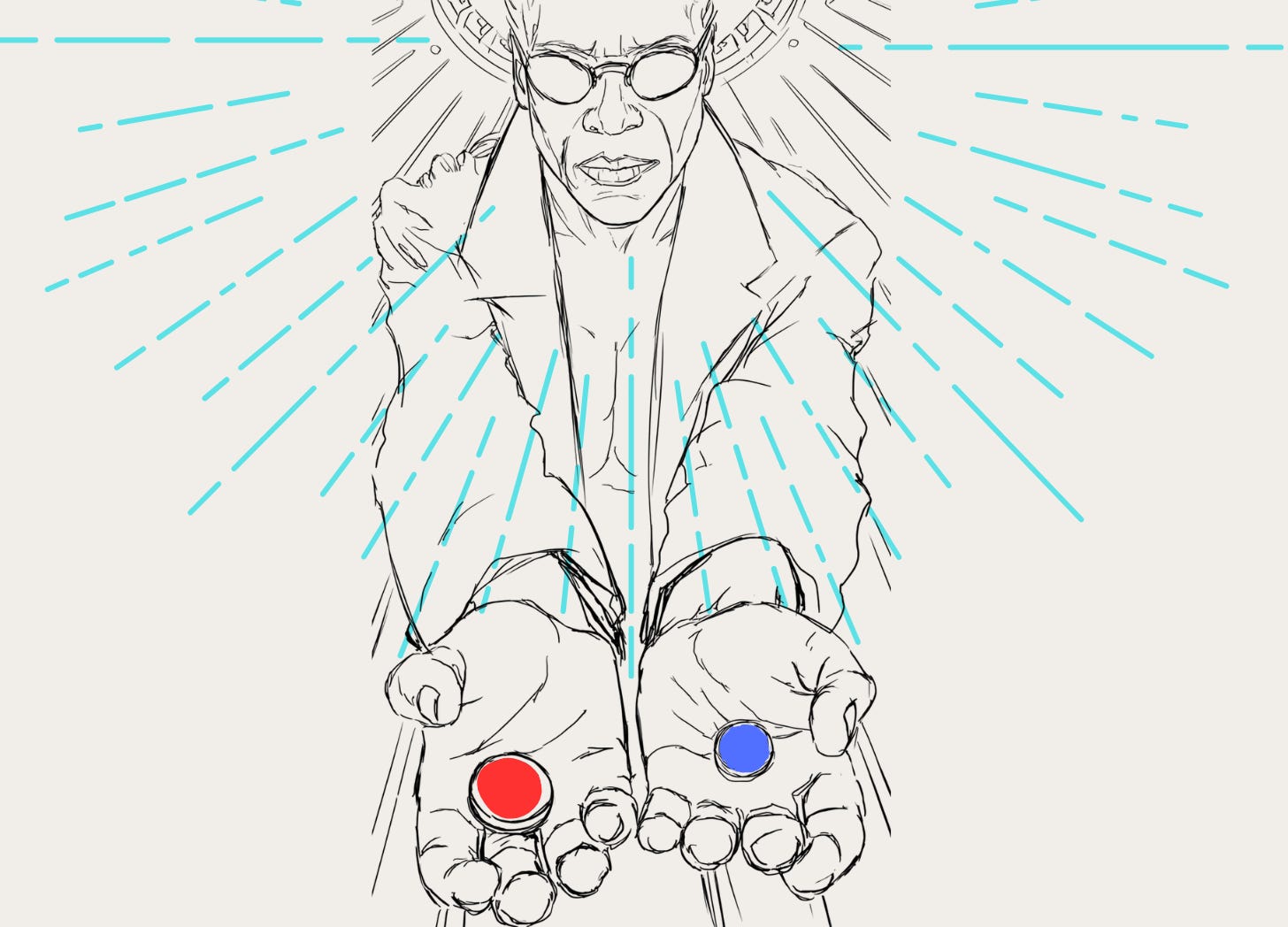
I remember seeing one of those Instagram street interviews a few years ago that made me pause. The interviewer asked a random person on the street, “What’s the hardest drug you’ve ever tried?”
After just a few seconds, the person replied, “Reality.”
I thought, ha! That’s good. It’s good because it’s true. Because we all feel it in our own way. Even if we can’t explain why.
Reality is what we’re born into and what we seem to have some role in shaping. It’s the tangible and incomprehensible entanglement of chaos and meaning that makes up our lives. Reality contains the multitude of our experiences, and yet, it’s also what many of us, in one form or another, are trying to escape.
Being alive is fucking hard. The human condition is filled with pain and pleasure. With inherent challenge and human-made suffering. We chase pleasure and avoid pain. We can spend our entire existence being somewhat detached from reality, or believing in the delusion that we’re somehow in control of it. Most of us have been humbled by reality. To experience it, as it is, fully, to surrender our ideas of what it should (or could) be and accept it without resistance, requires the kind of courage that can take lifetimes to earn.
It’s in reality where we have the power to facilitate change. Yet it’s outside of (physical) reality where we have the potential to imagine something entirely different. This is the dance we have to learn. To be grounded in the now without losing connection to our creative powers.
Einstein said, “Reality is merely an illusion, albeit a very persistent one.” If reality is an illusion, then it must be malleable, not fixed.
I used to think that our perception shaped our reality, but now I know it’s our responses and decisions that alter the course of our lives. What’s real is what is already occurring. And what’s real is also what’s possible. We are always one decision away from an alternative future. So we can shape reality, but only if we’re willing to dance with it. To take risks and to take responsibility for where they lead us. The more we consciously choose, the deeper our relationship with reality becomes, and the more we can influence our experience of life.
A realist is a person who perceives the world as it presents itself. An idealist reaches beyond what is to imagine the world as it could be. We need aspects of both to be effective visionaries and contributors. Reality is often less than ideal because the ideal is usually stripped of pain and difficulty. This also shows up in how we think about Utopia vs Dystopia, one world is a fantasy of perfection, while the other reflects our deepest fears. We have enough evidence to know that we can bend and stretch reality. Sometimes our lives reflect what we allow ourselves to believe is possible, but possibility is always shaped by the systemic barriers we’re operating within. Our greatest power comes from learning to work within the limits of our current reality to translate potential into form.
The events that shape our lives
We are each (and all) moving through life, navigating events as they occur. Events can be internally or externally induced. Linear or cyclical. One time or recurring. Things happen to us, and we also make things happen (consciously and unconsciously). Events prompt us to feel, recalibrate, and make sense of our worlds. Regardless of how big or small, they almost always require us to respond by making a series of decisions that demand change. Even if that change is changing our minds.
An event is an occurrence that disrupts the rhythm of our individual and collective existence. An illness, the purchase of a house, someone quitting, selling your company, a car accident, graduating from college, a natural disaster, having a baby. As my friend ‘M’ says, planned or unplanned, “Something is always coming.” Events occur at the micro and macro levels. An event can be as small as an unexpected conversation or as large as a global pandemic that forces people worldwide to confront mortality and loss of control.
In a sense, reality can be described as a series of interconnected events and choices that span across time. Sometimes we can access the dials to influence outcomes, and other times we have little to no control over our fate. People with privilege often say that our lives are a reflection of the choices we’ve made. But our lives are just as much a reflection of the events we never chose, the things we were forced to confront, and how we responded to the choices made for us. It’s delusional to think we always have some choice in what happens; sometimes the only choice we have is how we emotionally respond. And even that response is shaped by a lifetime of experiences that formed our instincts, beliefs, and conditioning.
Still, we have the power to create change. If not individually, then collectively. Awareness is the gateway to potential because it turns acceptance into agency rather than hopelessness or apathy. But change requires more than will and courage. It requires resources, too. The more resources we have, the more leverage and influence we have, the more instantly and easily we can change our lives. But that access doesn’t necessarily make our reality better; sometimes, it makes it more challenging because we can buy our way out of pain and discomfort, which are, more often than not, necessary ingredients for personal and collective evolution.
The business of reality
There are entire industries and businesses designed to help us escape, enhance, or manage our experience of reality. From alcohol to porn to games to films to travel to social media, we can temporarily immersive ourselves in a world far from our own, or a world far from struggle, and relieve ourselves of the predicament of being human.
But no matter how far we go, we always have to come back. To be human is to be limited.
And those limits, despite being frustrating, are remarkably powerful. Without limits, everything is available, everything is expected, and nothing is meaningful. When everything is available, nothing is valuable. Limits protect us from the unbearable weight of endless possibility. They force us to make decisions, focus, commit, and create within our constraints.
These can all be positive things, but consumer culture tells us otherwise.
What we desire, pursue, and purchase often reflect our relationship to reality. The world sells us the fantasy of having and becoming everything by belittling the concept of an “average” or “simple” life. But that narrative is false, and it’s driving us to personal burnout, resource depletion, and societal collapse. An average or simple life is not less than, just as a life of accomplishment and luxury is not more than. A meaningful life is one in which our relationship with reality doesn’t exceed our resources and capacity, but isn’t limited by fear and scarcity.
What we create and build also reflects our relationship to reality. Whether we’re selling hope or connection, confidence or success, eternal youth or endless pleasure, we are making commentary on what we believe reality is, and what it could be.
Every brand, product, and message wants you to believe in something, and it’s typically one of these:
More will make you happier. More money, more love, more sex, more beauty, more success, more status.
You can avoid pain with comfort, convenience, distraction, or escape.
You can transform into who you wish you were. A more optimized, confident, extraordinary version of you.
Ultimately, they’re all saying the same thing: you will be fulfilled once your life becomes different from the one you’re living now.
But chasing happiness is, in many ways, the opposite of reality. If reality exists on a spectrum of joy and grief, and nothing can permanently change the human condition, then anything promising a life without pain, uncertainty, or discomfort is selling a fantasy. Politicians and CEOs are exceptionally good at selling fantasies.
The next time you see an ad or a political campaign, ask yourself: What version of reality is this selling me? Who will I/we become on the other side of this promise?
The relationship between imagination and reality
Reality asks us to commit to something, someone, some place, maybe all of the above. And we struggle with commitment because we often experience it as a lack of freedom. But commitment is the birthplace of possibility. Only by rooting ourselves can our branches grow and our flowers bloom.
Exploration and experimentation shape our personalities and worldviews. Curiosity and novelty are foundational to creativity and connection, but neither is productive when pursued boundlessly. Even in the classic Hero’s Journey framework, the Hero eventually returns to the Ordinary World. The endless search for the elixir of life will leave us empty or full of despair.
I’ve written about dreaming as a technology and the role of imagination in determining our futures. But imagination is a tool, not a driver. Imagination is limitless, creation isn’t. At some point, we have to draw a line in the sand and play within it. And not forever, for a little while. Until it feels natural to expand our horizons again. When we pay attention, the process of imagining and creating new realities becomes instinctual and intrinsic. Never forced.
Inevitably, limitlessness becomes delusion. To think that we can outsmart reality is a form of narcissism, an insistence that we should be exempt from the laws that apply to everyone else. Reality is not a game to be played. It responds to what we do, not what we dream about. You don’t “win” by playing strategically from the sidelines; you transform by being willing to participate. Reality is something to be felt, to be experienced, rather than observed or manipulated. The observer can dissect reality from a distance, but only the one who enters the arena, who accepts risk and responsibility, can mould it.
Fantasy protects us from pain, but it also protects us from depth. When we optimize for pleasure, we experience the breadth of reality. The quality of our life can be measured by how much we have and what we get to do. But when we commit to training, practice, and growth, when we focus, when we don’t run from struggle and discomfort, we sink deeper into reality and taste the elixir of life.
Imagination can expand reality to epic proportions, but it’s conscious creation, the act of executing on our ideas—of who to be, where to live, what to do with our time, who to love—without being distracted by every shiny new object, that enables us to build something real, something that changes the world, maybe even something that outlives us.
wonderfully expressed! loved every word and resonated to the care. Glad I came across this newsletter.
My response to "reality" and/or "imagination" is pondering "fate" and/or "destiny". As I've imagined the conundrum - Fate is that which we are born into. Fate is being born in to a genetic mutation, a life long physical challenge, the nation, environment, and culture. Then there's your parents, and extended family, who play more of a direct role in shaping everything, until maturity allows the individual to "think" for themselves, to get out of the house, to decide how to fashion their adult family, and how to survive and thrive according to one's own terms. Destiny is the vehicle through which "free will" manifests. Destiny is what one makes out of their fate. There is no way to "prove" fate vs destiny - but one might imagine destiny as a concept is created out of a mix of reality and imagination; and destiny is what one can create in a shape shifting reality.
I take issue with the term karma, as that theory implies there is a tracking service that carries over between lifetimes. Some may call it "Mind stream". What I cringe at is the notion that one's "karma" can't be fulfilled in a single lifetime. How can one say a baby born in poverty must have been an ungrateful selfish person in a previous lifetime? I'll leave that topic alone for now. :-)