Skill, Strategy, and Luck
A framework for navigating potential and possibility

I’m taking a week off from writing, the next post will be published on March 1, 2026.
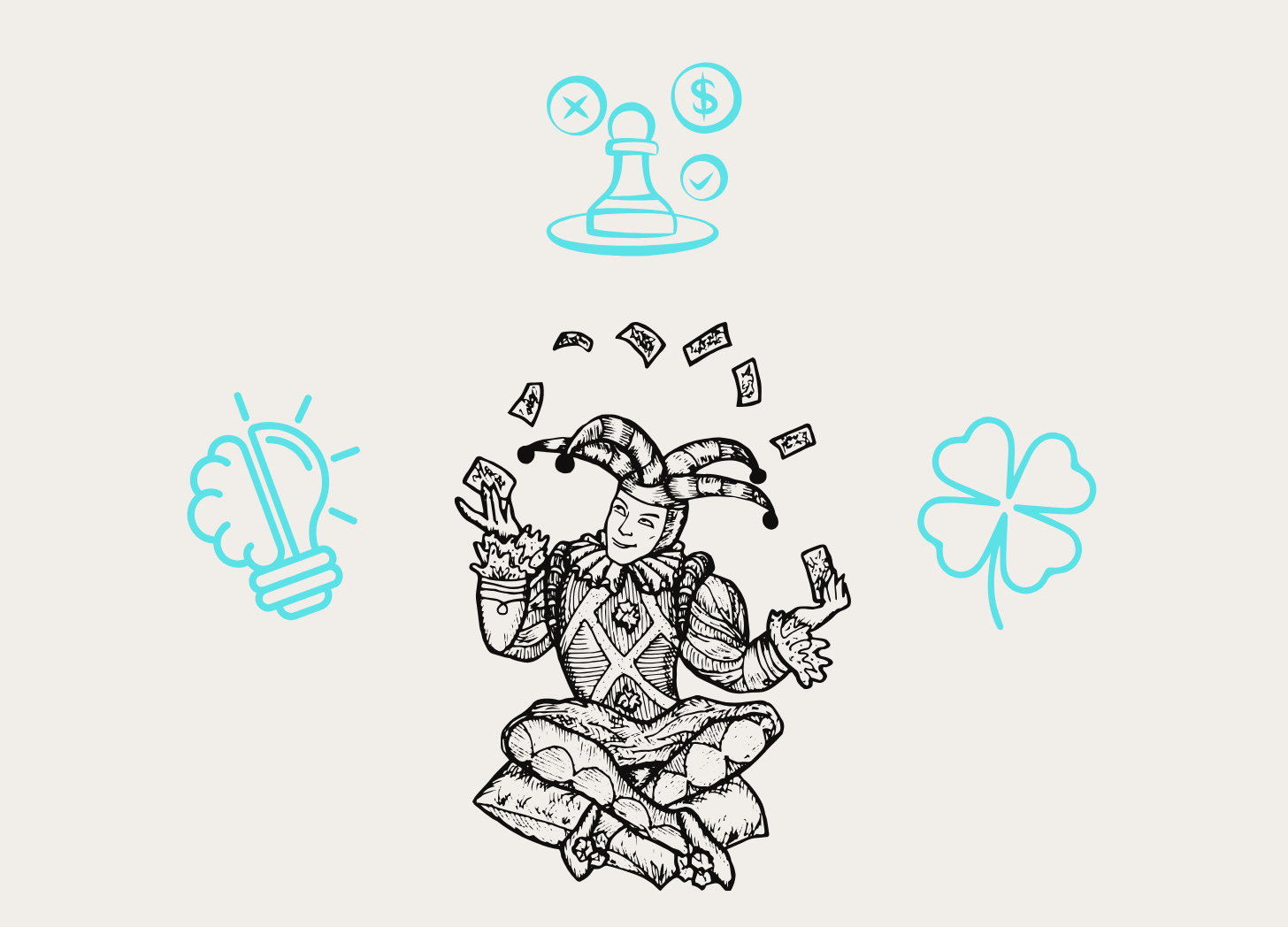
Everything requires some combination of skill, strategy, and luck.
Skill is a specific talent or expertise. Strategy is the unique set of decisions and tactics we use to achieve a desired outcome. Luck, being the most unpredictable of the three, is about timing and circumstance.
All three contribute to what ultimately happens, and increasing the likelihood of ending up where we want starts with understanding how much weight each carries. That clarity helps us decide where to invest effort and resources.
Most people tend to overindex on what they can control, so they overinvest in skills. Learning more. Doing more. Getting better. But if skill is 20% of the equation, and you’re spending 80% of your time on it, it will shrink your range of possibilities before it moves you closer to your north star. The value of skill is changing. With AI, many cognitive skills might become completely irrelevant in the next 5-10 years. Discerning which skills to double down on is now a skill in itself.
Strategy is also within our control, but not to the same extent as skill. Skill is about capability, strategy is about direction. Skills improve with practice, strategy only works when it responds and adapts to reality.
Luck is the wild card. It plays at least a small role in most things, but it’s often miscalculated. When we refer to someone as “lucky,” we usually mean they were in the right place at the right time. But luck isn’t entirely random; within social and economic systems, it’s shaped by power and access. We can understand it better when we break it into sub-categories:
Pure luck (e.g. winning the lottery)
Earned luck (e.g. not giving up)
Inherited luck (e.g. having loving parents)
Structural privilege disguised as luck (e.g. race, class)
We know how to cultivate skills; it’s what most of us learned in school. We understand the importance of strategy, even if we weren’t formally taught it. But we have a fraught relationship with luck because it’s been misconstrued in modern society. On the one hand, we know privilege plays a role; on the other, we don’t want to admit how much.
Luck is not a skill, but our relationship to luck is something we can develop. We may not be able to control luck, but we can design our lives to encounter it more often. We won’t eliminate or escape inequality, but with the right skills and strategy, we can expand our surface area for opportunity.
How to get lucky
The old school approach to increasing luck is through relationships. Be in the right rooms, meet the right people, and be prepared for when opportunity knocks on your door. Who you know matters; it’s an undeniable factor, so I won’t reiterate the obvious.
Aside from relationships, there are three ways to influence luck:
Take more shots.
Notice patterns.
Think like a futurist.
Take more shots. Repetition, if you can afford it, increases your odds of winning. Not just because you can develop a skill, but because repetition increases exposure to chance. With every attempt, you learn and adjust your strategy. Try to throw a ball in a hoop 10 times, and you might miss every time. Keep going, and you might make it on the 15th try.
More trials = more opportunities for something to work. Repetition is the bridge between effort and chance.
Notice patterns. Chess is a strategic game, but it’s also a game of pattern recognition. Learning to read the board and your opponent informs which moves you make. The better you can recognize patterns, the more accurately you can predict what’s coming. Pattern recognition requires presence; presence is a skill. Without presence, everything looks chaotic. With it, structure begins to emerge.
More attention = increased capacity to read and organize signals. Eventually, this becomes foresight.
Think like a futurist. Futurists are mental time travellers. Beyond pattern recognition, thinking like a futurist means using imagination and data to explore a range of possibilities and probabilities. When we model probabilities, we can reverse-engineer strategies to achieve them. Long, broad thinking forces us to consider scenarios and variables that short-term thinking often misses.
*Long-term thinking = expanded strategic range. Not only does it build resilience, but it also, more importantly, teaches us to make decisions with clarity and agency.
People who get lucky or have ideas that succeed are sometimes the ones who never stopped trying, despite their losses. People who consistently make good decisions use pattern recognition to turn information into leverage. People who think in decades make different choices than people who think in days.
Even within inequitable systems, our approach can sometimes determine our luck.
*Long-term thinking shouldn’t come at the expense of short-term thinking. There are many problems with long-termism. A better term might be ‘generational thinking’, which has been practiced by many Indigenous peoples for thousands of years.
Everything changes with machines
The next few decades might require more strategy than skill. The context and conditions we live in will change faster than ever, so we have to learn to respond quickly and effectively.
Personally and professionally, we’ll be forced into a new kind of survival, where legacy systems collide with intelligent machines. Those who can confidently pivot and those who can make their own luck will have an advantage in the new world.
Technology expands our potential, but when it outpaces our abilities, it forces us to rethink excellence and value exchange. When machines outperform humans at a task, the task stops being a primary source of human status, and new forms of value emerge. For centuries, we used skill, strategy, and luck to compete with one another within the boundaries of human limits. The rules are changing. The future is already here in specific domains. Right now, even the greatest chess players in the world, who have devoted their lives to pefrecting their game, can’t beat machines.
Machines don’t get tired.
Machines don’t get distracted.
Machines make calculations at unmatched speed.
But we’re not doomed. Humans have one evolutionary advantage: we can adapt. So we’ll evolve to develop new skills and strategies, and I speculate four defining shifts.
First, we’ll get better at leveraging machines as extensions of our own thinking. Those who learn how to use AI most effectively will be able to do more and move faster. Second, and in the complete opposite direction, we’ll return to craft. Care, taste, judgment, and mastery will matter more than ever. Third, we’ll rediscover the value of genuine human connection. Trust, presence, love, and emotional intelligence can’t be produced. Real connection will become a form of currency. And last but not least, “intellectual supremacy” will shift, and we’ll desire more somatic, body-based practices that anchor us back in the physical experience of being human.
Opportunities will emerge and disappear faster, so those who can spot and act on them first will be the lucky ones. Instead of being in the right room, our opportunities may depend on which tools we have access to. When creating and building become easier, cheaper, and faster, the quality of ideas and their timing will become even more important. As information becomes abundant, knowledge won’t be as valuable, learning how to read and respond to situations will become non-negotiable.
To thrive in the next world, we’ll need to develop new strategies rooted in social, cultural, and emotional intelligence. And most importantly, we’ll need to invest in the one skill that governs all other skills: discernment.